Techno Multi Services
The 2026 Industrial Guide to MPCB Wastewater Discharge Norms
Compliance Limits, OCEMS Mandates & STP/ETP Audit Protocols
Operating an industrial manufacturing facility or commercial infrastructure campus in Maharashtra has entered an era of unprecedented environmental scrutiny. With the Maharashtra Pollution Control Board (MPCB) and Central Pollution Control Board (CPCB) deploying automated real-time surveillance, drone aerial mapping, and continuous IoT-based water telemetry, the margin for wastewater non-compliance has effectively collapsed to zero.
For Plant Heads, Factory Managers, and Environment, Health & Safety (EHS) Directors operating across high-density manufacturing clusters—such as Chakan MIDC, Bhosari, Ranjangaon, Talegaon, and Kurkumbh—a single non-compliant treated water grab sample or an uncalibrated online sensor can trigger immediate bank guarantee forfeiture, astronomical environmental damage compensation (EDC), or catastrophic Section 33A closure orders under the Water (Prevention and Control of Pollution) Act, 1974.
This comprehensive engineering guide outlines the updated 2026–2027 MPCB treated wastewater discharge standards, analyzes the mandatory Online Continuous Effluent Monitoring System (OCEMS) integration protocols, identifies the root causes of biological and chemical treatment failures, and delivers a battle-tested 5-step audit checklist to safeguard your facility’s operational continuity.
1. Maharashtra Pollution Control Board (MPCB) Discharge Norms Master Matrix (2026)
Discharge standards enforced by MPCB vary fundamentally depending on the receiving body: inland surface water bodies, public municipal sewers connected to Common Effluent Treatment Plants (CETP), or controlled land application for on-site gardening and irrigation.
Water Quality Parameter |
Inland Surface Water Discharge |
Public Sewer / CETP Inlet |
Land for On-Site Irrigation |
Sampling & Testing Protocol |
|
|---|---|---|---|---|---|
|
Initial Capital Investment (CAPEX)
|
₹38,00,000 – ₹55,00,000
|
₹1,45,00,000 – ₹2,35,00,000
|
ZLD CAPEX is driven by SS316L/Titanium metallurgy for evaporators, high-pressure booster pumps, and UF/RO skids.
|
||
|
Connected Electrical Load (kW)
|
22 kW – 35 kW
|
85 kW – 130 kW
|
High-pressure RO pumps (70 bar) and MEE vacuum circulation pumps consume heavy continuous power.
|
||
|
Thermal Energy / Steam Consumption
|
Zero (Ambient biological process)
|
0.28 to 0.35 Tons steam per m³ of RO reject evaporated
|
MEE requires low-pressure steam (3 to 4 bar) generated via briquette, coal, or gas boilers.
|
||
|
Daily Operating Cost (OPEX per day)
|
₹3,500 – ₹4,800 / day
|
₹16,500 – ₹24,000 / day
|
ZLD OPEX is ~4.5x higher due to boiler fuel, antiscalants, and thermal operator shifts.
|
||
|
Cost per Cubic Meter Treated (₹ / m³)
|
₹35 – ₹48 / m³
|
₹165 – ₹240 / m³
|
ZLD water cost must be balanced against savings from avoided fresh industrial water purchases. |
||
|
Water Recovery Efficiency (%)
|
0% – 40% (Only suitable for gardening)
|
95% – 98% High Purity Permeate
|
ZLD permeate (TDS < 50 ppm) can directly replace costly DM water in high-pressure cooling towers and boilers. |
||
|
Hazardous Solid Waste Generation
|
Dewatered biological/chemical sludge (approx. 40–60 kg/day)
|
Chemical sludge + Crystalline mixed dry salt (approx. 380–520 kg/day)
|
ZLD salt must be manifested and dispatched to registered CHWTSDF sites (e.g., MEPL Ranjangaon).
|
- The Conventional ETP Flowsheet
A conventional turnkey Effluent Treatment Plants (ETP) relies on a sequential combination of physico-chemical coagulation, biological oxidation, and tertiary media filtration. Its sole objective is to lower biodegradable organics, suspended solids, and heavy metals below statutory environmental limits for discharge into an MIDC public sewer or nearby watercourse:
- Primary Physico-Chemical Stage :- Equalization tank with coarse air mixing → Flash mixer (dosing alum/ferric chloride and lime for pH neutralization) → Flocculator (dosing anionic polyacrylamide) → Primary Tube Settler.
- Secondary Biological Stage :- Pressure Sand Filter (PSF) → Activated Carbon Filter (ACF) → Chlorine/Ozone disinfection → Treated water discharge.
- Tertiary Polishing Stage :- Aerobic biological oxidation using Activated Sludge Process (ASP) or Moving Bed Biofilm Reactor (MBBR) carriers → Secondary Clarifier with activated sludge recycle (RAS).
Limitation: A conventional ETP removes suspended solids, BOD, and heavy metals, but leaves dissolved mineral salts (TDS: chlorides, sulfates, sodium) completely untreated. If raw effluent has a TDS of 4,000 mg/L, the treated discharge will still register ~4,000 mg/L.
- The Closed-Loop ZLD Flowsheet
A Zero Liquid Discharge (ZLD) systems is an advanced engineering architecture that separates wastewater into two distinct streams: high-purity recycled water (95% to 98% volumetric recovery) and dry, solid crystallizer salt cake suitable for hazardous landfill disposal:
- Pre-Treatment Skid :- Advanced chemical softening (lime-soda softening to reduce calcium and magnesium hardness < 20 ppm) → Microfiltration or Ultrafiltration (UF) with 0.02-micron hollow-fiber membranes to achieve a Silt Density Index (SDI) < 2.5.
- Membrane Concentration Skid :- Multi-stage brackish water RO → High-Pressure Disc Tube RO (DTRO operating at 75 to 120 bar) concentrating effluent TDS from 5,000 mg/L up to 65,000–85,000 mg/L, while recovering 85% to 90% as clean boiler-feed water.
- Thermal Evaporation Skid :- Multiple Effect Evaporator (MEE: typically 3 to 4 falling film effects with thermal vapor recompression - TVR) treating RO reject → Agitated Thin Film Dryer (ATFD) or Centrifuge recovering dry crystalline mixed salts.
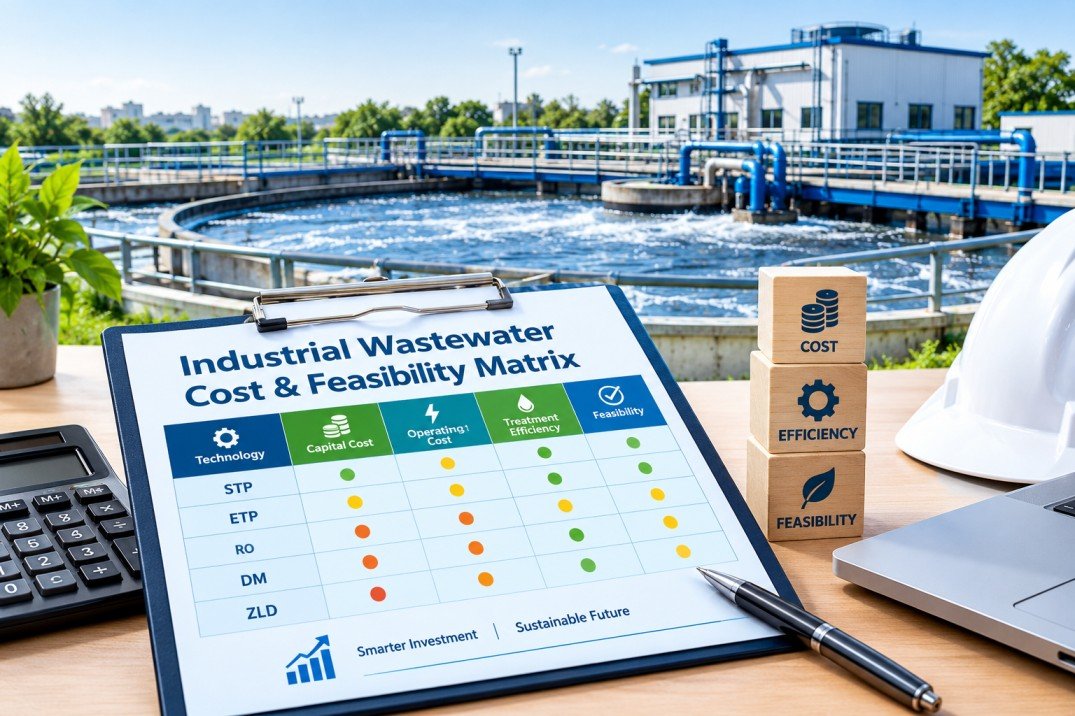
2. 100 KLD Financial Modeling: 2026 CAPEX vs. OPEX Comparison Matrix
The table below provides a verified financial breakdown for an industrial manufacturing facility in Pune MIDC (Chakan/Bhosari) handling 100 $m^3$/day of industrial effluent with average Raw Water characteristics: COD: 1,800 mg/L, BOD: 600 mg/L, TSS: 450 mg/L, and TDS: 5,500 mg/L.
Financial & Technical Parameter |
Conventional ETP Skid (100 KLD) |
Complete ZLD Skid with MEE (100 KLD) |
Engineering Cost Driver Analysis |
|---|---|---|---|
|
Initial Capital Investment (CAPEX)
|
₹38,00,000 – ₹55,00,000
|
₹1,45,00,000 – ₹2,35,00,000
|
ZLD CAPEX is driven by SS316L/Titanium metallurgy for evaporators, high-pressure booster pumps, and UF/RO skids.
|
|
Connected Electrical Load (kW)
|
22 kW – 35 kW
|
85 kW – 130 kW
|
High-pressure RO pumps (70 bar) and MEE vacuum circulation pumps consume heavy continuous power.
|
|
Thermal Energy / Steam Consumption
|
Zero (Ambient biological process)
|
0.28 to 0.35 Tons steam per m³ of RO reject evaporated
|
MEE requires low-pressure steam (3 to 4 bar) generated via briquette, coal, or gas boilers.
|
|
Daily Operating Cost (OPEX per day)
|
₹3,500 – ₹4,800 / day
|
₹16,500 – ₹24,000 / day
|
ZLD OPEX is ~4.5x higher due to boiler fuel, antiscalants, and thermal operator shifts.
|
|
Cost per Cubic Meter Treated (₹ / m³)
|
₹35 – ₹48 / m³
|
₹165 – ₹240 / m³
|
ZLD water cost must be balanced against savings from avoided fresh industrial water purchases. |
|
Water Recovery Efficiency (%)
|
0% – 40% (Only suitable for gardening)
|
95% – 98% High Purity Permeate
|
ZLD permeate (TDS < 50 ppm) can directly replace costly DM water in high-pressure cooling towers and boilers. |
|
Hazardous Solid Waste Generation
|
Dewatered biological/chemical sludge (approx. 40–60 kg/day)
|
Chemical sludge + Crystalline mixed dry salt (approx. 380–520 kg/day)
|
ZLD salt must be manifested and dispatched to registered CHWTSDF sites (e.g., MEPL Ranjangaon).
|
3. Membrane Pre-Concentration: Sashing ZLD Thermal OPEX by up to 60%
The single most catastrophic financial error industrial plants make when adopting ZLD is feeding low-concentration effluent directly into a thermal evaporator. Evaporating water using thermal steam costs approximately ₹450 to ₹750 per cubic meter, whereas removing water using high-efficiency membrane reverse osmosis costs only ₹18 to ₹35 per cubic meter.
By integrating a high-recovery industrial RO plant equipped with Disc Tube RO (DTRO) or High-Pressure Brackish Water (BWRO) membranes operating at 75 to 90 bar pressure, the effluent volume entering the thermal MEE can be reduced by 80% to 88%:
By integrating a high-recovery industrial RO plant equipped with Disc Tube RO (DTRO) or High-Pressure Brackish Water (BWRO) membranes operating at 75 to 90 bar pressure, the effluent volume entering the thermal MEE can be reduced by 80% to 88%:
The Membrane Pre-Concentration Formula: Feeding 100 KLD of effluent at 5,000 mg/L TDS into a 2-stage High-Recovery RO skid yields 85 KLD of high-purity permeate water (reusable in cooling towers or boilers) and only 15 KLD of concentrated reject (TDS ~33,000 mg/L).
Result: Instead of sizing a 100 KLD Multiple Effect Evaporator (CAPEX ₹1.2 Cr, consuming 30 tons of steam daily), the factory only needs a compact 15 KLD MEE (CAPEX ₹35 Lakhs, consuming only 4.5 tons of steam daily). This single engineering optimization slashes lifetime operational expenditure by over 55%!
To safeguard these expensive membranes from scaling and organic fouling, plant managers must enforce strict preventive membrane maintenance and CIP SOP protocols, ensuring silt density indexes and antiscalant dosing are rigorously controlled.
4. Maharashtra Regulatory Triggers: When is ZLD Legally Mandated?
In Maharashtra, selecting between an ETP and ZLD is not purely an internal financial choice; it is frequently determined by geographic and statutory parameters established by the MPCB:
- Notified River Basin Zones :- Facilities located within the Upper Bhima basin, Mula-Mutha watershed, or within 5 km of primary drinking water reservoirs are prohibited from discharging industrial effluent into natural surface nullahs, irrespective of COD/BOD levels.
- Non-CETP Connected MIDCs :- In industrial estates lacking a functional Common Effluent Treatment Plant (or where the local CETP operates at maximum hydraulic capacity), all Red-Category industries (Electroplating, Galvanizing, Bulk Drugs, Pigments, Chemical Formulations) must operate a closed-loop ZLD facility with zero liquid outlet pipes.
- Consent to Establish (CTE) TDS Ceiling:- If raw effluent TDS consistently exceeds 5,000 mg/L and local CETP membership norms cap inlet TDS at 2,100 mg/L, the factory has no alternative but to implement RO concentration and thermal crystallization.
5. The Plant Director’s 5-Point Engineering Decision Framework
Before issuing an equipment tender or finalizing your environmental capex budget, run your facility’s parameters through this diagnostic logic tree:
- Diagnostic Logic Tree for Industrial Effluent Management :-
- Step 1: Raw Effluent TDS < 2,000 mg/L and Permitted CETP Discharge Available?
- → Action: Install a conventional chemical/biological ETP with tertiary filtration. ZLD is unnecessary.
- Step 2: Raw Effluent TDS > 3,500 mg/L but Factory Located in High-TDS Discharging CETP Zone?
- → Action: Primary Physico-Chemical treatment followed by biological treatment. Pre-treat heavy metals and discharge to CETP.
- Step 3: Factory Operates Steam Boilers and Purchases Tanker Water at > ₹120/m³?
- → Action: Implement ETP + High-Recovery RO. The recovered permeate water replaces expensive fresh tanker purchases and can be fed into industrial demineralization (DM) plants for pure boiler makeup.
- Step 4: MPCB CTE Condition Mandates Zero Discharge or Basin Discharge Prohibited?
- → Action: Full ZLD is legally required. Design an optimized flowsheet: Physico-Chemical → Biological → Ultrafiltration → High-Pressure RO (DTRO) → MEE with TVR → ATFD.
Frequently Asked Questions (High-Value Technical & Commercial Answers)
Yes. An existing biological/chemical ETP can serve as the primary pre-treatment module for a ZLD system. The facility simply installs a downstream Ultrafiltration (UF) polishing skid, high-recovery reverse osmosis skids, and an appropriately sized thermal evaporator to handle the concentrated RO reject.
Disc Tube RO (DTRO) utilizes open-channel, flat circular membrane cushions mounted on a hydraulic shaft. Unlike spiral-wound RO membranes that easily foul and block when handling high-COD or high-TDS streams, DTRO operates with high turbulence and can handle raw feeds up to 100 bar pressure, concentrating effluent up to 80,000 mg/L TDS without membrane fouling.
The crystalline salt cake recovered from an ATFD consists of mixed industrial salts (sodium chloride, sodium sulfate, and residual heavy metals). It is classified as hazardous chemical waste and must be packed in HDPE bags and manifested for disposal at an authorized Common Hazardous Waste Treatment, Storage, and Disposal Facility (CHWTSDF).
Our Other Treatment Posts
Need an Independent Treatability & Salt Balance Study?
Techno Multi Services (TMS Water Solutions) provides pilot-scale treatability evaluations, high-recovery membrane simulations, and turnkey engineering across Pune, Chakan, Bhosari, Ranjangaon, and Talegaon.