Techno Multi Services
Zero Liquid Discharge Plant in Manufacturer Pune
Turnkey Zero Liquid Discharge (ZLD) Plant Engineering in Pune & Maharashtra
Industrial manufacturing sectors classified under the Central Pollution Control Board (CPCB) “Red Category”—including basic organic chemicals, pharmaceuticals, agrochemicals, dyes, electroplating, and distilleries—operate under strict regulatory scrutiny. In industrial zones such as Kurkumbh, Ranjangaon, Chakan, Roha, and Taloja, the Maharashtra Pollution Control Board (MPCB) legally mandates Zero Liquid Discharge (ZLD) as an unconditional prerequisite in Consent to Establish (CTE) and Consent to Operate (CTO) renewals.
Under a ZLD mandate, an industrial facility is strictly prohibited from discharging a single drop of treated or untreated liquid effluent into public sewers, common effluent treatment plants (CETP), rivers, nullahs, or onto land. Every liter of wastewater must be treated, purified, and recycled within the manufacturing boundary, with residual dissolved contaminants converted into dry solid salt cakes for authorized hazardous waste landfill disposal.
However, designing and operating a ZLD system represents the ultimate challenge in chemical process engineering. Inadequately engineered thermal evaporators suffer severe tube scaling, foaming, and accelerated corrosion from boiling concentrated chlorides and sulfates. Conventional evaporators turn into massive financial drains, consuming unsustainable amounts of boiler steam and electrical power. Without integrated high-recovery membrane pre-concentration, thermal evaporation operating costs (OPEX) can exceed ₹1,500 to ₹3,000 per 1,000 liters, crippling factory profit margins.
Engineered Solution & Technical Value Proposition
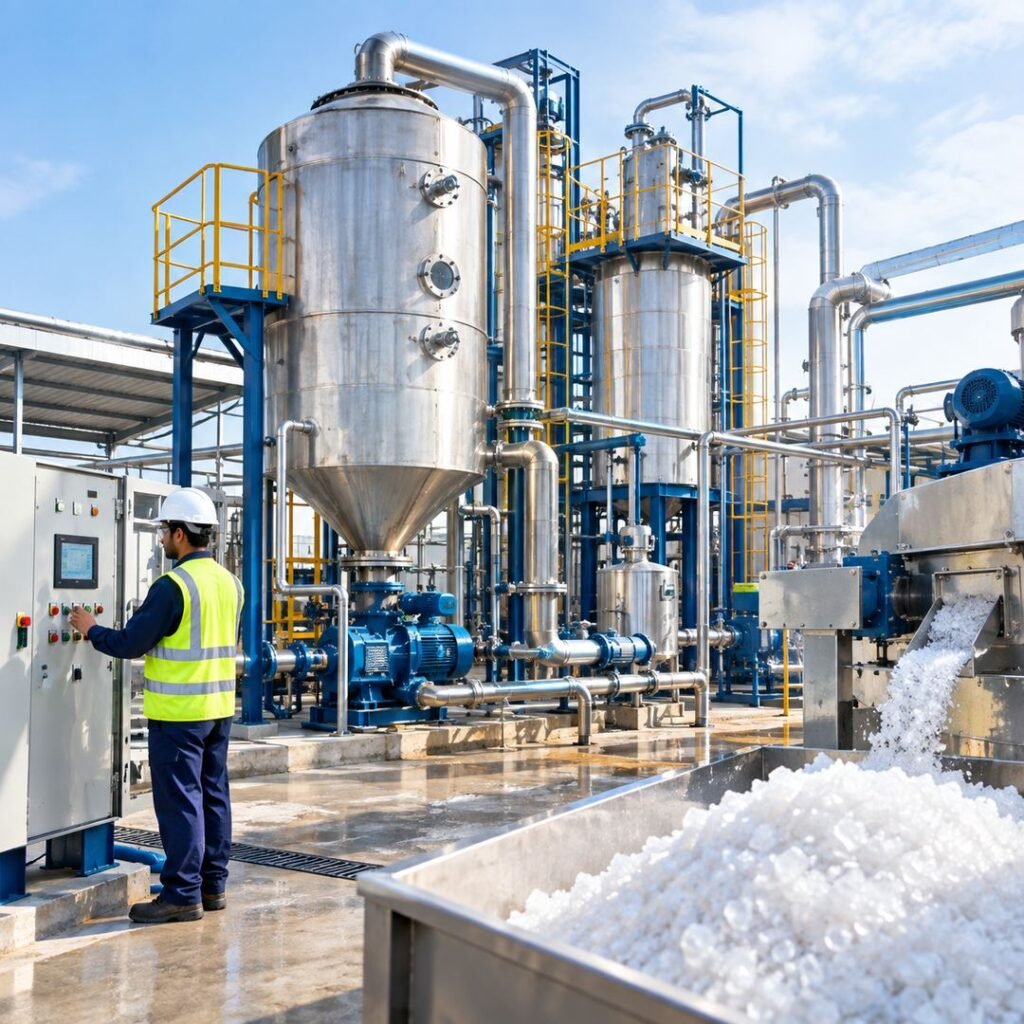
Techno Multi Services (TMS Water Solution) engineers comprehensive, economically optimized Zero Liquid Discharge (ZLD) systems that minimize thermal operational costs while guaranteeing 100% environmental compliance. Backed by rigorous thermal and mass-balance process engineering from AISSMS College of Engineering Pune, our ZLD methodology utilizes a four-tier hybrid train: Advanced Pre-Treatment -> High-Recovery Membrane Concentration -> Thermal Multiple Effect Evaporation (MEE) -> Final Crystallization & ATFD Drying.
High-Recovery Membrane Brine Concentration
Integration of Ultrafiltration (UF) and High-Pressure Disc-Tube Reverse Osmosis (DTRO / SWRO) operating at pressures up to 80 to 120 bar. Concentrates wastewater TDS from 5,000 ppm up to 75,000–100,000 ppm, recovering up to 85% pure water at low electrical cost before entering thermal evaporation.
Multiple Effect Evaporator (MEE - Falling Film & Forced Circulation)
Thermally optimized multi-stage evaporation utilizing steam reuse across 3 to 5 effects in series, enhanced with Thermal Vapor Recompression (TVR). Falling film effects handle initial evaporation at low temperature differences, while axial forced circulation effects handle slurry crystallization without scaling heat exchanger tubes.
Agitated Thin Film Dryer (ATFD) / Crystallizer
Precision-machined vertical or horizontal thermal dryer equipped with internal rotating hinged wiper blades. Continuously spreads concentrated evaporator slurry into a turbulent thin film against heated jacket walls, boiling off the final water and scraping dry solid salt crystals into collection bags.
Industry Niche Applications Pune
Agrochemicals, Pesticides & Dye Intermediates
ZLD plants engineered for high-salinity, toxic organic mother liquors utilizing corrosion-resistant Titanium Grade 2 and Hastelloy calandrias.
Kurkumbh MIDC, Ranjangaon, Roha
Active Pharmaceutical Ingredients (API) Bulk Drugs
High-purity distillate recovery returning pharmaceutical-grade boiler feed water while crystallizing hazardous process salts.
Kurkumbh, Chakan, Tarapur
Automotive Paint Shops & Heavy Electroplating
Heavy metal precipitation combined with closed-loop DTRO and compact forced-circulation MEE delivering zero wastewater discharge.
Chakan MIDC, Bhosari, Talegaon
Textile Processing & Dyeing Mills
Brine recovery systems recovering up to 90% sodium sulfate and sodium chloride salts for direct reuse in dye baths.
Solapur, Ichalkaranji, Baramati
Engineering Specifications & Design Parameters
Parameter / Metric |
Inlet / Raw Water Standard |
TMS Guaranteed Outlet / Treated Standard |
|---|---|---|
|
Total Plant Water Recovery
|
100% Raw Effluent
|
> 95% – 98% Distillate & Permeate
|
|
Liquid Discharge to Environment
|
100% Effluent Volume
|
Absolute Zero (0.00 LPH)
|
|
MEE Distillate TDS
|
50,000 – 120,000 ppm
|
< 50 – 100 ppm (Boiler grade)
|
|
ATFD Output Moisture
|
60 – 70% Slurry
|
< 5.0% Dry Solid Salt Powder
|
|
Steam Economy (MEE with TVR)
|
—
|
3.2 to 4.5 kg water evaporated / kg steam
|
|
Hazardous Solid Waste Disposal
|
—
|
Dry cake to authorized CHWTSDF
|
- Capacity Range - 10 KLD, 25 KLD, 50 KLD, 100 KLD, 250 KLD to 1,000 KLD+ (10 m³/day to 1,000 m³/day)
- Materials of Construction - Titanium Gr. 2 for high chloride brines, Hastelloy C276, SS316L, and specialized FRP/PP-H vapor ducting.
- Automation & Instrumentation - Comprehensive SCADA system with automated vacuum controllers, level transmitters, density meters, desuperheaters, and automated anti-foam dosing.
6-Step Turnkey Project Delivery Workflow
- 01. Effluent Thermodynamics & Boiling Point Elevation (BPE) Audit - Laboratory testing to determine salt solubility curves, organic volatility, scaling indexes, and BPE kinetics.
- 02. Comprehensive Mass & Energy Balance Simulation - Software modeling optimizing membrane vs. thermal evaporation staging to achieve the lowest possible lifecycle OPEX.
- 03. Calandria & Pressure Vessel Fabrication - Precision fabrication of heat exchangers, flash chambers, and ATFD bodies in ASME-certified shops with X-ray weld inspection.
- 04. Field Erection & Heavy Structural Erection - Erection of multi-tier structural steel towers, titanium piping, barometric condensers, and vacuum ejector circuits.
- 05. Pre-Commissioning Hydro & Vacuum Trials - Vacuum holding tests (-720 mmHg), hydrostatic testing of steam lines, and fresh water baseline thermal performance testing.
- 06. Live Effluent Commissioning & MPCB Compliance Handover- Live effluent feed ramp-up, steam economy verification, solid cake output validation, and submission of final ZLD handover report.
Frequently Asked Questions (High-Value Technical & Commercial Answers)
Thermal evaporation requires enormous latent heat to boil water (approximately 540 kcal/kg). Operating a thermal evaporator directly on raw wastewater results in exorbitant steam and electrical expenses (often exceeding ₹2,500 per 1,000 liters). TMS optimizes ZLD lifecycle costs by squeezing out the maximum possible volume of water using advanced low-energy membranes (High-Pressure RO / DTRO) before thermal evaporation. By reducing the volume entering the evaporator by 80% to 85%, we slash boiler steam consumption and total plant OPEX by up to 60%.
In a Falling Film Evaporator, liquid flows down as a thin film inside vertical heat exchanger tubes, offering exceptionally high heat transfer coefficients and low temperature differences; it is ideal for concentrating dilute to moderate brines without scaling. A Forced Circulation Evaporator uses a high-flow axial pump to pump concentrated slurry through calandria tubes under high pressure, preventing boiling inside the tubes. Boiling occurs only when the liquid flashes into the vapor separator chamber, preventing tube scaling and making it essential for crystallizing saturated brines.
The solid salt cake produced by an Agitated Thin Film Dryer (ATFD) is classified as Category 35.3 Hazardous Waste under the Hazardous and Other Wastes (Management and Transboundary Movement) Rules. The dry crystals are automatically bagged in UN-approved HDPE woven bags, labeled with Form 9 hazardous manifests, and transported to authorized Common Hazardous Waste Treatment, Storage, and Disposal Facilities (CHWTSDF)—such as MEPL Ranjangaon—for scientific landfill disposal.
Yes. Thermal distillate from our Multiple Effect Evaporators typically has a TDS < 50 ppm and low conductivity (< 80 µS/cm). After passing through a small carbon filter and polishing ion-exchange bed, this high-purity recovered water is superior to raw groundwater and can be fed directly back into high-pressure boilers or cooling towers, creating a true closed-loop circular water economy.
Boiling brine containing high chloride concentrations (> 20,000 ppm) causes rapid stress corrosion cracking and pitting in conventional SS304 or standard SS316 steel. For aggressive chloride effluents, TMS utilizes Titanium Grade 2 or Hastelloy C276 for heating tubes and calandrias, ensuring 20+ years of operational equipment lifespan without corrosion leaks.
Our Other Treatment Services
Achieve 100% ZLD Legal Compliance Without Crippling Operating Costs
Request a Comprehensive Mass Balance & Thermal Optimization Simulation from Senior ZLD Specialists.