Techno Multi Services
Demineralization Plants Manufacturer in Pune
High-Purity Demineralization (DM) Plant Manufacturer in Pune & Maharashtra
High-pressure steam boilers, power generation turbines, and precision manufacturing sectors (chemical synthesis, microelectronics, battery cell production, and pharmaceutical manufacturing) cannot tolerate even trace quantities of dissolved mineral ions. When boiler feed water contains dissolved cations (Calcium, Magnesium, Sodium) and anions (Chlorides, Sulfates, Bicarbonates, and Silica), high operational temperatures and pressures trigger severe degradation mechanisms.
Silica ($SiO_2$) presents an insidious threat: at boiler pressures exceeding 40 bar, silica volatilizes into the steam phase and carries over directly into steam turbines. As the steam expands and cools across turbine blades, silica deposits as a glassy, rock-hard ceramic coating, destroying aerodynamic blade profiles, causing catastrophic rotor imbalance, and resulting in millions of rupees in turbine failure.
Similarly, dissolved chloride and sulfate ions penetrate passive metal oxide layers, causing rapid stress corrosion cracking and pitting in expensive boiler tubes. Relying on poorly engineered ion-exchange plants with inefficient resin kinetics, channelized beds, or substandard regeneration systems leads to premature ionic slippage, frequent boiler blowdowns, massive thermal energy loss, and unscheduled plant shutdowns.
Engineered Solution & Technical Value Proposition
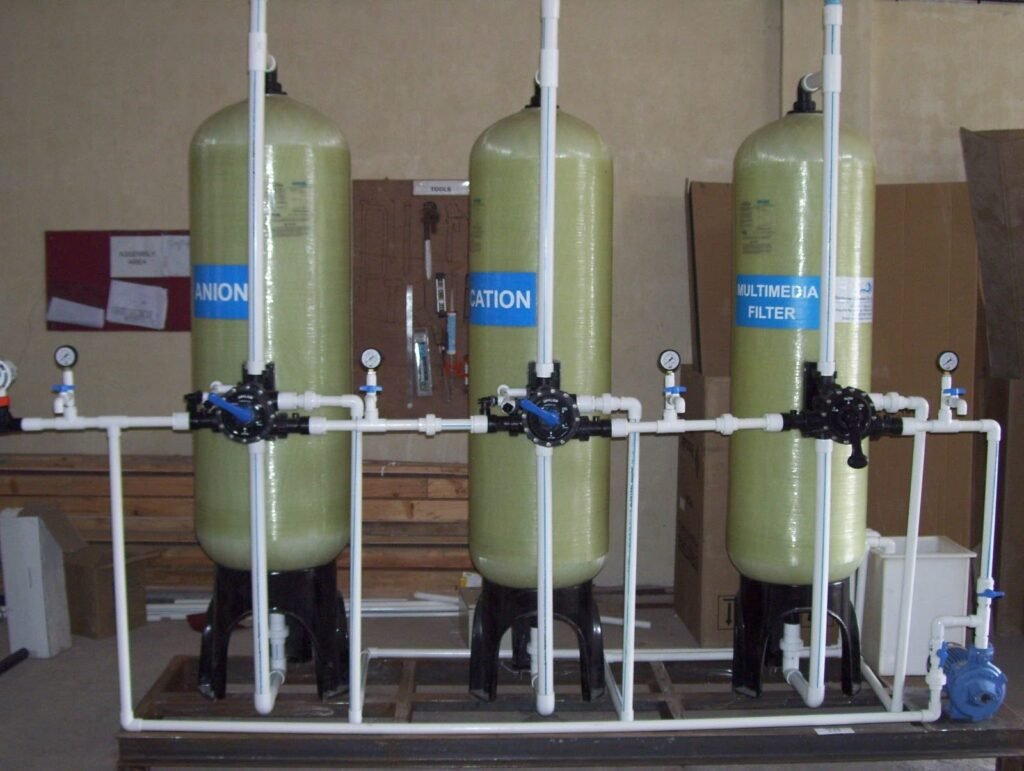
Techno Multi Services (TMS Water Solution) engineers high-performance Two-Bed (Cation-Anion) and Mixed Bed (MB) Demineralization (DM) Plants designed to strip dissolved minerals down to parts-per-billion (ppb) levels. Grounded in chemical engineering precision from AISSMS College of Engineering Pune, our demineralizers feature packed-bed counter-current regeneration technology, premium uniform-particle-size ion exchange resins, and degasser carbon dioxide stripping towers to deliver ultrapure water with conductivity < 0.1 µS/cm.
Two-Bed Demineralizer (SAC - SBA)
Primary demineralization train featuring a Strong Acid Cation (SAC) resin column in hydrogen ($H^+$) form followed by a Strong Base Anion (SBA) column in hydroxide ($OH^-$) form, stripping bulk ionic load to produce water with conductivity < 10 µS/cm.
Degasser Tower Integration
Forced-draft packed column degasser positioned between cation and anion columns. Strips dissolved carbon dioxide ($CO_2$) gas formed by carbonic acid breakdown, reducing the ionic load on the SBA resin by up to 50% and slashing caustic consumption.
Mixed Bed (MB) Polisher
High-purity polishing vessel containing an intimate mixture of SAC and SBA resins in a 1:1.5 stoichiometric ratio. Functions as thousands of micro two-bed units in series, polishing water to conductivity < 0.1 µS/cm and silica < 0.02 ppm.
Industry Niche Applications Pune
Thermal Power Plants & Captive Co-Generation
Ultra-pure boiler makeup water ensuring zero silica deposition on turbine blades and maximizing thermal boiler efficiency.
Kurkumbh, Baramati, Solapur, Daund
Chemical Processing & Fertilizer Synthesis
Demineralized process water preventing unwanted ionic catalytic reactions in synthetic chemical formulations.
Ranjangaon MIDC, Roha, Rasayani, Taloja
Battery Manufacturing & Solar Cell Production
Deionized water with conductivity < 0.1 µS/cm and zero heavy metals for lead-acid and lithium-ion electrolyte dilution.
Chakan, Talegaon, Supa
Automotive Electro-Deposition (CED) Paint Shops
High-resistivity DI water (> 10 Megaohm-cm) for continuous bath replenishment and final body-shell rinse cycles.
Chakan MIDC, Bhosari, Waluj (Aurangabad)
Engineering Specifications & Design Parameters
Parameter / Metric |
Inlet / Raw Water Standard |
TMS Guaranteed Outlet / Treated Standard |
|---|---|---|
|
Feed Water TDS
|
Up to 800 ppm
|
TDS < 1.0 ppm (Near zero)
|
|
Conductivity (Two-Bed)
|
300 – 1,200 µS/cm
|
< 5.0 – 10.0 µS/cm
|
|
Conductivity (with Mixed Bed)
|
< 10.0 µS/cm
|
< 0.1 – 0.2 µS/cm
|
|
Reactive Silica (as SiO₂)
|
10 – 40 mg/L
|
< 0.02 mg/L (20 ppb)
|
|
pH Value
|
7.0 – 8.5
|
6.8 – 7.2 (Neutral)
|
|
Total Hardness
|
100 – 500 ppm
|
Nil (Undetectable)
|
- Capacity Range - 500 LPH, 1,000 LPH, 2,500 LPH, 5,000 LPH, 10,000 LPH, 20,000 LPH to 50,000 LPH+
- Materials of Construction - Rubber-Lined Mild Steel (RLMS with 4.5mm hard natural rubber), High-Grade FRP composite vessels, and PVDF/PP lined piping.
- Automation & Instrumentation - Manual multiport valve, pneumatic diaphragm valve battery with PLC control, automated regeneration sequence with online conductivity/pH alarms.
6-Step Turnkey Project Delivery Workflow
- 01. Water Ionic Profile & Mineral Analysis - Detailed lab ion analysis quantifying total cations, strong base anions, weak acids (silica, carbonic acid), and FMA (Free Mineral Acidity).
- 02. Resin Volume & Bed Geometry Engineering - Computerized sizing of resin exchange capacity, optimal bed depth (minimum 1,000mm), and linear flow velocity (15–30 m/hr).
- 03. Pressure Vessel Fabrication & Rubber Lining - Precision fabrication of vessel shells, internal lateral strainer hubs, spark testing of 4.5mm vulcanized rubber lining at 15,000V.
- 04. Skid Piping & Chemical Eductor Assembly - Corrosion-proof piping in Schedule 80 PVC/PP, assembly of acid/alkali storage tanks, air blowers, and ejector skids.
- 05. Resin Charging & Commissioning Sequence - Stratified loading of graded gravel support, virgin SAC and SBA resin, backwash classification, and full chemical regeneration.
- 06. Output Validation & Water Quality Handover- Continuous 24-hour conductivity logging, silica colorimetric testing, and comprehensive training on acid/caustic handling safety.
Frequently Asked Questions (High-Value Technical & Commercial Answers)
A Two-Bed DM plant consists of two separate vessels: a Strong Acid Cation (SAC) column and a Strong Base Anion (SBA) column, producing demineralized water with conductivity between 2.0 and 10.0 µS/cm. A Mixed Bed (MB) plant combines both cation and anion resins within a single vessel; because water touches millions of alternating resin beads in series, it polishes water to extreme purity: conductivity < 0.1 µS/cm and silica < 0.02 ppm, which is mandatory for high-pressure power plant boilers.
In the cation column, water's natural bicarbonates are converted into dissolved carbonic acid ($H_2CO_3$), which breaks down into water and dissolved carbon dioxide gas ($CO_2$). If left in the water, this $CO_2$ acts as a weak acid that rapidly exhausts the expensive Strong Base Anion (SBA) resin. A forced-draft degasser tower strips out 90%+ of this $CO_2$ gas using air blowing, drastically reducing the anion resin volume needed and cutting expensive caustic soda (NaOH) regeneration consumption by up to 50%.
Regeneration frequency depends on your feed water total dissolved solids (TDS), the volume of treated water produced, and your resin bed capacity. Systems are typically designed for an Output Between Regenerations (OBR) of 8 to 24 hours of continuous operation. When the online conductivity meter detects an ionic slip (> 10 µS/cm for two-bed, or > 0.5 µS/cm for MB), the automated regeneration cycle is initiated using HCl and NaOH.
For industrial durability, Mild Steel with 4.5mm natural hard vulcanized Rubber Lining (RLMS) is the industry gold standard due to its immense structural strength and complete chemical immunity to aggressive acids and alkalis. For smaller commercial flows (up to 5,000 LPH), high-pressure composite Fiber-Reinforced Plastic (FRP) with polyethylene inner liners offers a cost-effective, non-corroding alternative.
Reverse Osmosis (RO) removes 98% to 99% of bulk dissolved minerals via physical membrane separation without using hazardous chemicals, but leaves residual minerals (TDS 10–30 ppm). A DM plant uses chemical ion exchange to remove 99.99%+ of minerals, achieving near-zero conductivity (< 0.1 µS/cm). Today's engineering best practice is an integrated **RO + MB System**: the RO plant strips 99% of bulk ions, and a small Mixed Bed polisher removes the remaining trace ions, eliminating the need for bulk acid/caustic storage while delivering ultrapure water.
Our Other Treatment Services
Protect High-Pressure Boilers & Turbines with Ultrapure DM Water
Request a Complete Water Ion Balance Audit & Custom DM Plant Engineering Proposal.