A Reverse Osmosis (RO) Plant is a modern water purification system that removes dissolved salts, chemicals, bacteria, and microorganisms from water. Moreover, RO technology is widely used in residential, commercial, and industrial applications to improve water quality and ensure safe consumption.
Therefore, RO plants play an important role in addressing water contamination issues and meeting drinking water standards across different sectors.
A Reverse Osmosis (RO) Plant is one of the most reliable and effective water purification systems used today. It works by forcing water through a semi-permeable membrane that removes dissolved salts, harmful minerals, microorganisms, and chemical impurities. RO technology is widely used in homes, industries, commercial facilities, hospitals, hotels, laboratories, and municipal water treatment systems, making it a powerful solution for areas where water quality is poor or contaminated. According to the World Health Organization (WHO), reverse osmosis is an effective method for improving drinking water quality.
What is an RO Plant?
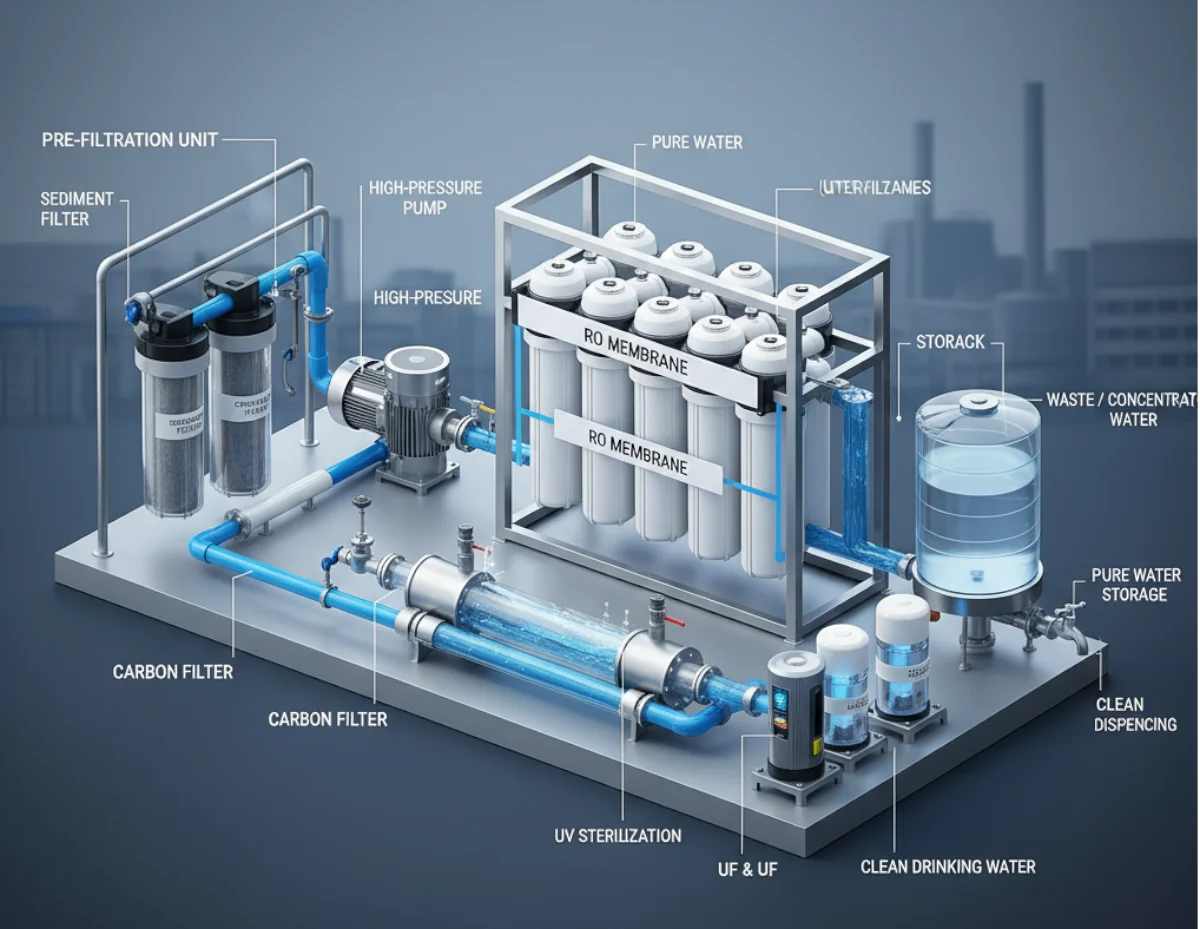
An RO plant consists of multiple treatment stages that work together to produce purified water. Each stage plays a critical role in protecting the membrane and improving water quality.
Pre-Filtration – Removes dirt, sand, and suspended particles
Activated Carbon – Eliminates chlorine, odor, and organic chemicals
High-Pressure Pump – Forces water through the RO membrane
RO Membrane – Removes dissolved salts and microorganisms
Post-Treatment – Final polishing to enhance water taste and clarity
Advantages of RO Plant
RO plants offer several benefits for both domestic and industrial users. Moreover, they ensure consistent water quality even in areas with highly contaminated sources.
- Removes 99% Dissolved Contaminants
Eliminates heavy metals, fluoride, chloride, pesticides, chemicals, bacteria & viruses. - Improves Taste, Odor & Color of Water – Removes unpleasant smell and enhances drinking water taste.
- Ensures Safe & Low-TDS Water – Provides pure and balanced mineral water suitable for residential and industrial use.
- Cost-Effective Long-Term Solution – Reduces the dependence on packaged water and lowers overall water usage cost.
- Protects Industrial Equipment & Boilers – Prevents scaling, corrosion, and mineral deposits on machinery and heat exchangers.
1. Domestic RO Plants
Used for homes and small offices to provide clean drinking water. These systems remove dissolved salts, bacteria, and impurities to ensure safe daily consumption.
2. Commercial RO Plants
Designed for schools, hotels, restaurants, gyms, and hospitals where a high volume of purified water is required throughout the day.
3. Industrial RO Plants
Used in manufacturing units, food processing industries, chemical plants, pharmaceutical companies, and textile units to treat process water and wastewater.
4. Brackish Water RO Systems
These systems treat water with higher salinity—ideal for areas with saline borewell water.
Common Problems in RO Plants & Their Solutions
1. High TDS in Output Water
Cause: Membrane damage or fouling.
Solution: Replace membrane, check pump pressure, and perform timely maintenance.
2. Low Water Flow
Cause: Clogged filters or low pump pressure.
Solution: Clean/replace pre-filters and check high-pressure pump.
3. Bad Taste or Odor
Cause: Saturated activated carbon filter.
Solution: Replace carbon filter and sanitize pipelines.
4. Increased Rejection Water
Cause: Improper membrane flushing.
Solution: Perform CIP (Cleaning in Place) and check membrane housing.
FAQs: RO Plant
1. What is an RO Plant?
An RO Plant is a water purification system that uses a semi-permeable membrane to remove dissolved salts, chemicals, minerals, microorganisms, and impurities from water to produce clean and safe water.
2. What type of water can be treated using an RO Plant?
RO plants can treat borewell water, river water, seawater, brackish water, and contaminated municipal water.
3. How does an RO Plant work?
Water is passed through multiple filtration stages such as sediment filter, carbon filter, high-pressure pump, RO membrane, and post-treatment to remove impurities and reduce TDS.
4. What are the common applications of RO Plants?
Industrial manufacturing units, pharmaceuticals, hospitals, hotels, commercial buildings, schools, apartments, laboratories, and packaged drinking water plants.